What alternatives are there to Soundcloud? (Part 4: Bandcamp)

There were various articles last summer predicting doom and gloom for Soundcloud before they were rescued. With that in mind, I did a little research into what alternatives independent musicians have to Soundcloud.

This is part 4 of the series aimed at independent artists. Comments relate to the free version of Bandcamp: there is a Pro subscription available allowing more advanced features like uploading videos and customising your bandcamp domain name, but it costs $10 per month, beyond the budget for many small artists.

Bandcamp's welcome page

Bandcamp’s front page

Bandcamp

Bandcamp is a well-established site for indie artists, geared up around selling downloads. Musicians can also allow listeners to stream their material, so they can decide if they will like it before they buy. Posting music here is a way of releasing material, but Bandcamp do not offer distribution services beyond their site, so this doesn’t get you onto Apple Music, Amazon, Spotify and so on: you will need to release your work through an additional distribution service if you want to get into those outlets.

Bandcamp is not a particularly suitable place for sharing rough mixes or material you’re not sure about to get feedback – listeners can’t leave comments and it may cause confusion if you post unfinished material in your store. That said, you can post tracks for free, allowing people to download for ‘£0 or more’, so that does give an option to differentiate between work in progress and finished items that you charge for. Anyone doing that would need to make sure it was well communicated, however, and there are possible reputation issues if you post work before it is really listenable.

There are some social aspects to Bandcamp, but it’s somewhat limited:  You can ‘like’ tracks via Facebook or tweet them directly from inside the site; music fans have their own pages and can follow each other as well as their favourite artists. Bandcamp encourage you to follow other fans with similar taste and check out their ‘collection’, to aid music discovery.  There’s also a music discovery page with features and which shows which albums or tracks are being bought right now, with the option to click through and listen. When you follow an artist, they can email to let you know when they have a new track available.

Pros:
Great for showing off albums.
Try-before-you-buy feature
You can limit the number of free streams of each track you allow listeners if you wish
You control the download price (unlike some online stores), and can offer free downloads on tracks you wish to share but not sell.
Fans can add a tip for the music they like best, when downloading.
Fans can follow artists they like, and artists can subsequently email them.
You can link your gig information to Bandcamp via the Songkick app.

Cons:
This site is not really suitable for getting feedback for work in progress.
The social dimension of the site is quite limited.
Music discovery is also fairly limited: users have to be actively seeking out new music.
Downloading is already on the wane – streaming is growing fast, but is not the focus of this site. This could affect the site’s relevance within just a few years, if the site does not adapt accordingly.

Verdict:
Where Bandcamp works best is as a well known online store, especially if you don’t provide music downloads direct from your own website. Because this site is very well known, it’s still a standard place for indie artists to be – at least for now.  You can use Bandcamp alongside your distribution deal (e.g. through CDBaby) providing that the distribution contract is non-exclusive, so that you get the benefit of being on both platforms.

Playlist of the Week (2018/6)

This week’s POTW is by GJART, another independent electronic musician, whose influences overlap a little with mine, as he is inspired by such familiar names as the Human League, Kraftwerk and OMD. If you want to check out his music, here’s a fab video he filmed and provided the music for with a wintry theme. You can also hear his tunes on Musicoin.org.

To give a boost to independent artists, GJART’s compiled the GJART loves #1 playlist of electronic music. (He also has a non-electronic playlist, GJART Loves #2 which I think you’ll also enjoy). The #1 playlist has a slightly industrial electronic vibe in keeping with GJART’s own influences, but is pretty chilled with it.

What alternatives are there to Soundcloud? (Part 3: Orfium)

This is the third installment in the series, exploring where independent musicians can make their music available to the public.

Orfium platform music discovery

Orfium platform music discovery

Orfium

The concept behind Orfium is the one-stop-shop and they are pitching themselves as the ‘answer to Soundcloud’. They have been around since 2016, and are a social network where you can also sell and monetize your music. The platform is effectively designed to be something like Soundcloud meets CDBaby. (Which would incidentally make a great combination if CDBaby were to get hold of Soundcloud.)

There’s no upfront or hosting cost. Orfium keep 20% of the revenue, if you decide to sell tracks through them rather than offer them for free. That means they are keeping 5% more than Bandcamp and CDBaby Free. On the plus side, Orfium can do more for you, as they can handle publishing, sync licensing, and YouTube monetisation, which aren’t part of the Bandcamp or CDBaby Free services.  (CD Baby can cover this, but you pay a fixed upfront fee to upgrade to either its ‘standard’ or ‘pro’ services, depending on your needs.)

So keen are Orfium to win over Soundcloud users that they have an ‘import from Soundcloud’ feature, however it only works with tracks that you’ve made available for download from Soundcloud.  There are not very many users just yet – charting tracks have a relatively small number of listens, which are currently dominated by a few bands; the ‘popular new music’ list mostly consists of tracks with less than a handful of plays. Electronic music dominates the site currently, possibly because this genre tends to adopt new tech early.

Pros:
-A very well-designed, professional-looking site.
-No upfront fees.
-If you make remixes, they can be featured alongside the originals.
-There’s a playlisting feature; playlists can be set to be public or private.
-They also cover Facebook monetisation.
-If your fans play your tracks on the site, you could gain the attention of other site users simply through being a relatively early adopter of the site.
-You can set external links to another site where you sell a track, instead of via Orfium.

Cons:
-If you want to sell through the site you could end up paying more in the long run than selling via a service with a fixed upfront fee, like CDBaby Standard, if you expect to make a lot of sales.
-There’s no app for it just yet (although they say there is one on the way).
-Downloads sold through the site are currently only available as mp3, not lossless files (although Orfium’s FAQs state that they plan to offer lossless later).
-A 20% charge on sales is a bit on the steep side. You’d have to weigh up whether you stand to gain overall via the additional sources of monetisation available like Facebook. Royalties/sales are also only paid to artists via Paypal or Payoneer, and in USD, so if you’re outside the States, expect additional fees.

Verdict:
This looks like a good site with a lot of potential, but it needs more music fans to use it. I don’t see it as a direct replacement to Soundcloud, as it seems better geared up for fully finished recordings, as it also offers distribution services.  The social side of the service seems more like a nice add-on to its distribution service at the moment, rather than being the core benefit, but that should change as more fans start to use the site. It is currently slightly better suited for electronic musicians, because there appear to be more electronic artists using the site, who will be bringing their fans to visit. Consider selling downloads through your own website, but using Orfium as the shop window, to lower your costs and to offer lossless quality files to listeners.

What alternatives are there to Soundcloud? (Part 2: Drooble)

There were various articles last summer predicting doom and gloom for Soundcloud before they were rescued. This prompted a little research into what alternatives there are to Soundcloud – this is the second of a series of posts into what I found out.

Drooble

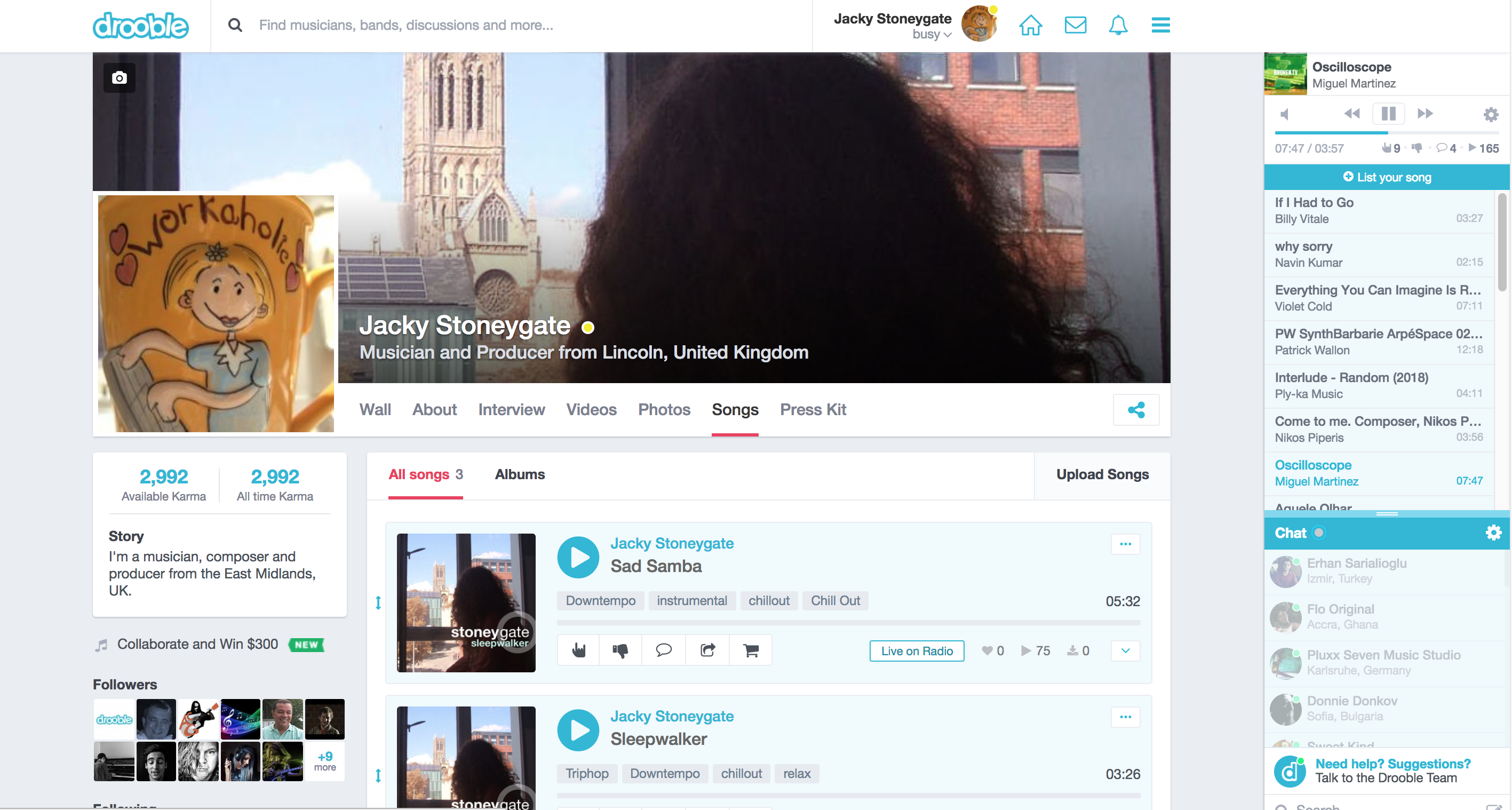
Stoneygate's Drooble Profile

Drooble’s website states, “We want to create a community that unites musicians. A place where you can connect with others to exchange ideas, share knowledge and start bands. A place where you can get your music appreciated and receive feedback from other musicians.”

The look and feel of this site is very much like Facebook, but with a musical twist. Like Soundcloud, this site is geared specifically for the music community, and there seems to be a mixture of musicians present, from keen amateurs to professionals, plus some music fans.  You can advertise and search for new band members and arrange jam sessions online.

Drooble is not a blockchain based site, but if listeners comment on or ‘applaud’ your music, you earn ‘karma points’. You also earn ‘karma points’ for being a good Drooble citizen: using it regularly, recommending friends and helping other musicians out. You can spend the points on promotional tools – it costs 400-700 points to get most of these, but additional airplay is just 100 points.

Songs uploaded to Drooble for hosting get automatic airtime on the site’s ‘radio’ station, which you might not want for work in progress. For getting feedback on unfinished material, it could be better to use host work in progress on a site like Clyp,  and only reference it from your Drooble feed.

The site is beginning to incorporate apps – so far there is a chromatic tuner and a metronome. They plan to include a built-in DAW further down the line, but I suspect that may be a while. I wouldn’t expect the Drooble DAW to have as much functionality as the DAW on your computer – unless the site’s creators work with one of the commercially available DAWs – but it could eventually be a useful tool for collaborating on co-writes with other Drooble musicians.

Pros
-You can post your music to the Drooble ‘radio station’, the built-in music player which allows commenting and likes.
-There is scope for being promoted as eg Artist of the Week or Video of the Week by spending your ‘karma points’.
-Built-in electronic press kit (EPK) as one of the promotional tools options.

Cons
-The genre communities are quite vaguely defined.
-Currently there are over 30,000 accounts* on the site, so the potential audience for your work is still quite small.
-All your instruments and genres are grouped together, so if you only play folk-style guitar but play rock keyboards and orchestral flute, this won’t be immediately clear to someone reading your page. That said, the level of detail you provide is way better than you can give on many sites.

Verdict:
This site is well designed, easy to use and has a lot of potential, especially if you collaborate with other musicians, and it is good for music discovery. It is probably geared up too much towards musicians rather than fans at present to draw in huge numbers of fans who aren’t musicians themselves. I would hope that this will be addressed as the site develops, though.

(This article was updated to state more than 30k accounts, on further information supplied by Drooble, as the number had increased since the article was written. It previously stated around 27k accounts existed).

Savannah

If you’re really eagle-eyed, you may have spotted that I’ve had a new video, Savannah, up on YouTube for a few months, but I haven’t mentioned it in this blog yet*.
This video was coded in Processing 3 (Java), again, similarly to some of my earlier videos, but I tried to design some rather basic animations that were more descriptive of the video’s theme this time around as well as messing around with some other visual ideas.
I’ve been more than a little distracted with my Dad’s ill-health the last few months. (That’s my best excuse for not posting something here about the Savannah video, and I’m sticking with it!). Dad’s still in hospital, but is doing a bit better now – most days, anyway – and I’ve been trying to catch up on Things I Started or Forgot About – this post is one of those. Soon I’ll be making more progress on some actual music, but I’ve got a tax return to sort first, and not a lot of time to do it.

Playlist of the Week (2018/3)

This week’s POTW is the Haven Yates’ Triple 25 Vol. 1 . I can’t tell you a great deal about Haven, apart from he writes some nice music, does some sound engineering as well as singing, songwriting, guitarring and producing and he seems like a decent bloke!  As you can probably tell from the name of the playlist, Haven has put together a few of these, so watch out for Vol. 4 coming up next week.

The super-eagle-eyed might have spotted one of Haven’s tracks, Find You, on one of my own Spotify playlists, How to Relax.

Playlist of the Week (2018/2)

This week’s playlist of the week is THE BIG ONE by Atom Collector Records. Atom Collector Records is a site where indie artists get together and share tracks and playlists, but you can also listen as a music fan to catch some music you’ve not heard before and find out more about the artists – you don’t need to be making music yourself. I like the ‘go’ button on the listen page for finding new music – you never know what you’re going to get, apart from the very broad genre you selected.

The BIG ONE playlist contains a huge variety of music from all genres so you can expect to be challenged at times and not to like absolutely everything (that’s what the skip button’s for, after all). The flip side is that I’m pretty sure that you’ll also find a few precious gems that you didn’t even know were out there.