Pick Myself Up & Start Again

The last few weeks have been a little rough. I worked fairly hard through January, then after helping out at a local community event on 4th Feb (just in the kitchen, no music involved) I was super-tired. I took the Sunday off to recuperate, but had a sore throat all day Monday, and then got ill for a couple of weeks with some sort of lurgy which just didn’t want to shift. The glands on my neck were up, my brain wasn’t on full power, and even simple tasks were wearing me out quickly. I was starting to wonder if I’d somehow managed to contract glandular fever* when things suddenly started improving and I began to get my life back again, just slowly.

Anyway, the reason I’m telling you all this is to explain why I vanished off the face of the internet for best part of a month now, bar a few random tweets. I’m working again, but it’s taking a while to get back up to my normal pace and have the energy to communicate. (Spot the introvert?).

I had wanted to work on what should become the second album this month, a set of instrumental tracks based on a well known novel. The aim was to write ten more minutes of music, give or take, to finish it off. I did make a start, but found I needed to do something where I was making more definite progress, before I move onto that project.
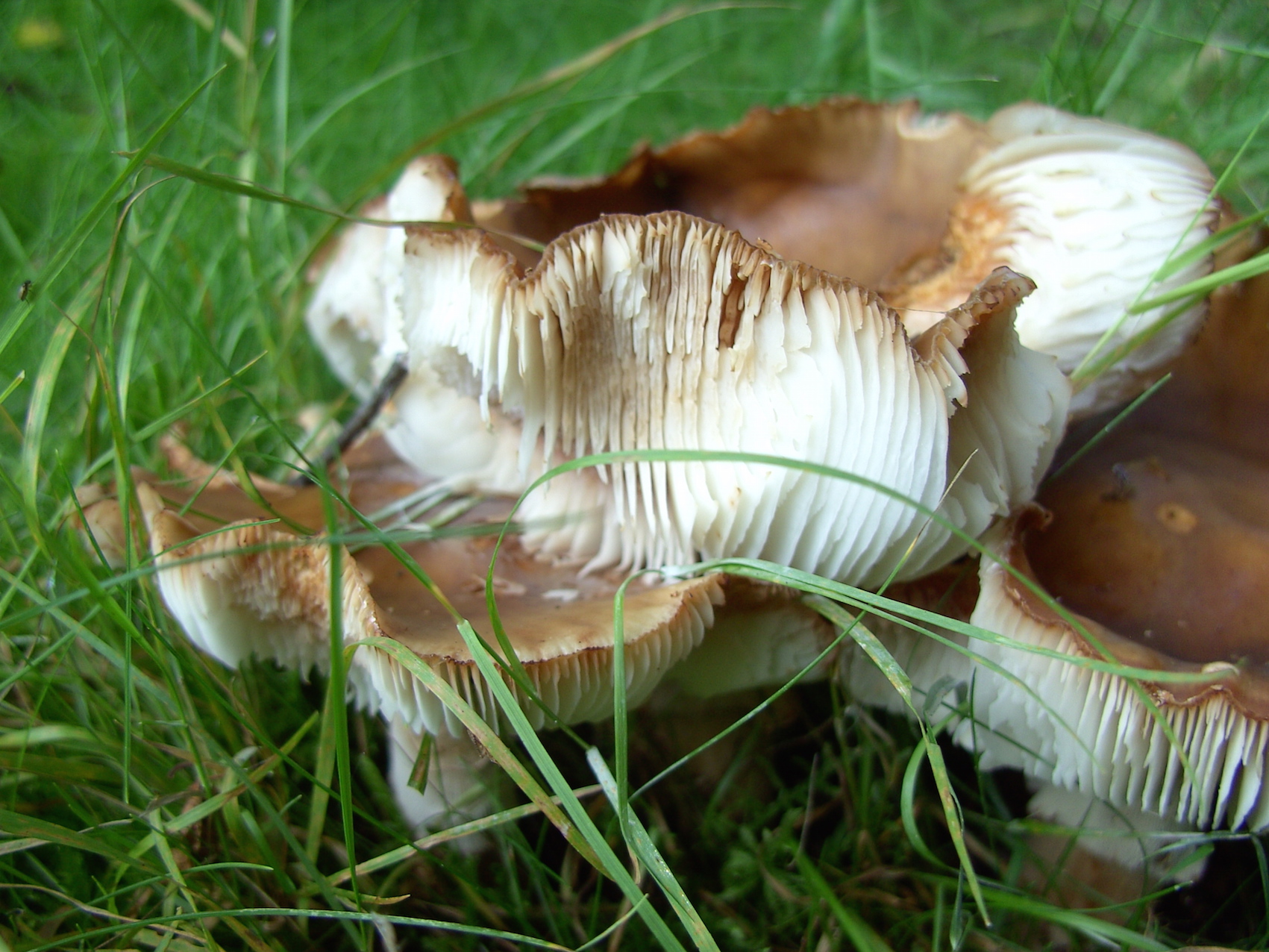
Mushrooms with brown top and white underside

So, there’s this song called Thieving Autumn which I have been working on intermittently since the end of September, and which I want to include on the third album, whenever that happens. I’m still not sure about all the lyrics, but I’ve gone ahead and started to work out instrumentation and parts for a recorded version, because that was more straightforward than writing something completely from scratch when my brain was still woolly from the lurgy.

Somehow the recorded version has ended up with a substantially different chord set to the guitar version I worked out in January, which is odd, because I have sung along to both. I haven’t figured out what’s happening there yet – some of the guitar chords may be alternatives, I may have accidentally taken it into a different key for the recording, or just not noted using a capo when I wrote down the chords in January.

I’ve got most of the backing track roughly together now, and need to work out how I want it to end. Then the main thing will be to do some serious work on developing the lyrics, trying to put into practice what I learned from the Berklee-based lyric-writing course I followed on Coursera last autumn. Off to the rhyming dictionaries!

*Glandular fever is called mono in the States.

Out with 2016!

This year has been a tough year in a lot of ways and I’m sure it’s not just me who will be glad to see the back of this year at midnight tonight.

But what of the future?  I have a few goals for 2017, but haven’t set myself any resolutions at this point. I actually tend not to even think about New Year’s resolutions until the start of the new year, if I make any at all. I would rather think in terms of broader goal-setting and trying to improve habits than setting impossible hurdles up for myself with the inevitable result of feeling bad for not managing to keep jumping over them. That said, I did start out on one of these schemes last year, with a rare NY resolution which required completing a daily task. I started to flag in about mid February and by the end of March it was all over with a big guilt trip. The main reason for not picking it up again, apart from it taking longer each day than I’d been led to believe, was because I would see long lists of dates in the past with unfinished tasks every time I looked at it. Looking back, I feel pleased with myself that I made it beyond the first few weeks.

So, instead of resolutions as such, I think I’ll be thinking for a little while in January about what I want to achieve next year and how I might go about it. Sometimes plotting and scheming isn’t the best way to get started though – it can be easier to just write a list of specific things that need doing and then attack them in an order that makes some sort of sense. You can spend too long thinking and not enough time doing…

I’d be interested to hear how readers of this blog approach New Year: Do you have any strategies you’ve used for making or keeping resolutions? Do you even make them, or do you do something else to mark the passing of the old year and look forward into the new one?


Vorsprung Durch Technik

After some more headbutting and reaching a point where I didn’t think I would be able to solve the original problem of routing live sound through a self-programmed music visualiser, I went back to basics. Ditching the sound module provided on the Creative Programming course, I looked into Processing’s own sound library using the online documentation.

And bingo, using the available sample code in the online tutorial, I suddenly had something that was responding to input from the soundcard. Just like that. The graphics were terrible – just a fuzzy line at the bottom of the screen, but the body was still twitching, so to speak.

So, moving on from there, I’ve incorporated the relevant commands into the visualiser code, and developed the graphics further to create something workable. The short video here is just a teaser: I want to keep the full graphics for live shows.  Here, output from Ableton Live Lite is being picked up by the visualiser from the signal going through the soundcard, and processed on the fly.

Digital Video, DIY style

I’ve already mentioned in previous posts that I’ve been working on a music visualiser application based on Digital Signal Processing (DSP) of sound, which could then be used to project images to screen during performances of my music.  It’s a significant detour from writing music itself, but would be particularly valuable for when I am performing instrumental pieces, to add interest to the listener experience. 

Unfortunately, I have a few challenges to overcome before my work so far can be used to animate live music. Namely, I can currently only use the visualiser on pre-recorded music, which obviously isn’t any good for live work, and it is only coping with small files at this stage. So, I need to learn how to get it to accept streaming audio, and figure out how to get a live sound signal into it.  If indeed that is possible.

I discovered another potential use for my work today, however, and that is to use the applications I’m writing to generate video art. It turns out that this is pretty easy to do by recording the app running on my screen with Quicktime then trimming it in video editing software.  The most difficult thing seems to be getting the sound and images to line up correctly where they are supposed to be synchronised, because recording the app running doesn’t capture the sound (unless that was a mistake on my part… I must check out if I missed any settings). I’ve probably not been completely accurate syncing up the attached example, but it’s close enough this time.

More Digital Art

This slideshow requires JavaScript.

I’ve kept going with the Creative Programming course that I talked about last time, and continued coding. After an amazingly good start, I reached a frustrating head-butting stage which I’m not sure I’m out of yet. I’ve now covered the whole syllabus, but need to go back and properly get to grips with waveform synthesis, to be able to do the last assignment and get the qualification. Plus, it might also be useful for performances if I can create an interesting and unique new digital instrument.

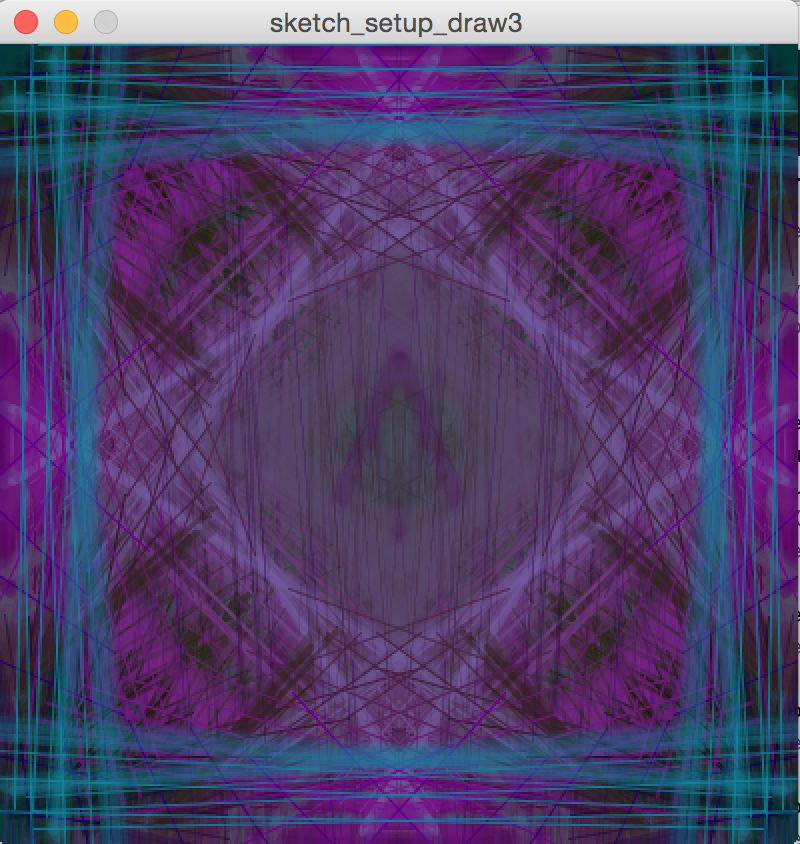
I’ve been working mostly on a music visualiser application based on Digital Signal Processing (DSP) of the sound, which I’ll talk about more in another post. In the meantime, whilst the visualiser is still in experimental mode, I thought I’d share a few more images I’ve created with my graphics-only app and an interactive version where sound was played and was changed in pitch and speed by what was happening on the screen.


A Worthwhile Detour


A couple of weeks ago, I went to a couple of events at Lincoln’s Sonophilia Festival (the UK one, not the one in Nebraska). One of these events was the Weird Garden experimental music club, and a chap called Dave C was demonstrating Lissajous curves by generating four tones using a Raspberry Pi and an Arduino board, then plotting these on an oscilloscope, projected so we could all see it. I thought that this would interest my Dad – he’s been known to experiment with a Raspberry Pi – and sent him some photos of the set-up.

Well, this started a conversation and a half. It basically headed in the direction of ‘you should learn some Digital Signal Processing’, with me misunderstanding what that might entail, thinking that it would involve circuit board design and a very steep learning curve. There was a lot of talk at cross-purposes, but Dad eventually explained I would need to learn some new programming skills, in a language called Visual DSP. The boards are already designed, so I wouldn’t need to worry about that, and you can do DSP on your computer, anyway, because computers already have the physical tools needed to do DSP.

I said I would look into it, so that I could possibly learn to present my music in a visual form when playing live. Any programming skills I pick up along the way are a bonus, anyway.  So, I enrolled on a several of Coursera courses, to check out the content, and got stuck into one of these, which I will follow through and hopefully complete.  This course isn’t specifically a DSP course, it is Creative Programming for Digital Media & Mobile Apps, but it seems to be pitched at about my level. It uses Java/Javascript (another language I haven’t used before) so any DSP I do when I get more advanced at programming might need to be via my computer, rather than an external board, unless there is a way round that… Actually, it looks like I can tell it to output the program in Python, the language that Raspberry Pi uses…. I have a lot to learn.

I’m still working my way through week 1 of the course, but the images above are all screenshots made from code that I put together* and then ran and interacted with to make art. I modified the code a little between each image captured.

Even if I get horribly stuck from here onward, I will have an app that I can use to make some unique album art!

*Disclaimer: my code also uses functions taken from a module coded by the course providers.

Failures and Successes

So, it’s been a few weeks since I posted here. I was trying to throw myself into Tune A Day June, but my efforts basically fell apart after about 11 days because I was super-tired at the end of the college year, and then needed to focus my efforts to prepare for the end of year gig on 1st July at one of the local pubs*, which is great at supporting the arts and especially music.

I was finding that because I was tired, it wasn’t a great time to be trying to write music, and I was not finding the deeper creative streak I wanted to reach.  What I really wanted to achieve was to write some more songs with lyrics, as I’ve focussed a lot on instrumental music during this year. But I was finding that in order to meet the requirement to make something every day for Tune A Day, I was going for the default option of writing a tune without lyrics, rather than approaching writing from the song’s meaning, taken from words. It wasn’t working and it was actually demotivating to be ‘failing’ like this. After taking some time out from forcing creativity, I’ve written some meaningful lyrics that I want to make use of at a later stage. It took a while before I started to find some natural creativity again, as I was beating myself up a bit (not literally, don’t worry!) for not being more productive, even when I had stopped pushing myself to make something. Stopping and just thinking about life and – critically – slowing down enough to observe have helped me find motivation.

The other important thing that I’ve started to do during this time – apart from helping my Dad out with some chores – is to learn more about how Ableton Live Lite works, after having had a brief introduction earlier in the year to Ableton at college and stewing on thoughts of how I might use Live Lite, its cut down version, for a while. This program should be very useful for my live performances, so I have also begun to transfer the songs that I played on 1st July into this new format so I can start to rehearse for a gig in September that I’ve been asked to do. (This gig request came from a friend who has persistently encouraged me to start doing Stoneygate gigs… and who helps organise a regular electronic music event.*)  Working in Ableton Live Lite looks like it could be more flexible and better suited to my music than working on the college’s Maschine unit I borrowed for the 1st July (at least in the way I was using it), and it looks like I’ll be able to make my live performances sound more similar to the recorded versions of my tracks with how I have started to work.

*If you would like details of future Stoneygate performances, so you can attend, and other significant news, please join my mailing list.